Wednesday, August 6, 2014

Final Post - End of Research

      It's hard to believe my REU is nearly over! I have a few more meetings today, and then a poster show tomorrow (see my poster at the end of this post!). My research has gone pretty well though, and I'm excited to present it.

      My project this summer was modelling a new pressure-controlled, hydro-mechanical transmission (PCHMT) for mid-size wind turbines in Simulink. I optimized and configured the transmission, and then examined its operation over several different wind speeds. I found that the best configuration using commercially available components looked like this:

     The planetary gears were sized to have a ratio of 1:16, the variable pump was sized to 110 cc/rev, and the pressure-controlled transmission (PCT) -- the motor-like component on the right -- was sized to 63 cc/rev. The PCHMT's core component is this PCT, which is basically a more efficient compact hydrostatic transmission (pump connected to motor) based on a vane pump with a floating ring at the output shaft.
     The PCT makes the system highly efficient - the transmission's efficiency was about 80% for wind speeds of 5 m/s to 11 m/s. This means that the PCHMT is a pretty good alternative to traditional mechanical gearboxes for wind turbines: it is efficient, as well as compact, reliable, less expensive to maintain, and commercially available (like all hydraulic transmissions for mid-size turbines).

      While I met my goal of  having efficiency data from an optimized system, I had hoped to compare it to similar data from other hydraulic transmissions (hydrostatic, a different hydro-mechanical). However, I did not have time to complete a dynamic simulation (one where the wind speed changes during simulation, to model real-life wind turbulence), so I could not compare my data to the other transmissions that were previously modeled with turbulence included. However, I hope that other researchers on my team will be able to use my Simulink model to complete a dynamic simulation with little trouble and empirically compare the PCHMT to other transmission options.

     Aside from my simulation's results, I gained both knowledge and experience this summer that I believe will help me as I start my career. My new knowledge about wind turbines should be very helpful, since I'm considering renewable energy (specifically wind turbines or solar panels) as a career focus. Also, I'm sure that my new skills and familiarity with Matlab and Simulink will come in handy in both my future schooling and career. Modelling and simulations are important in a lot of engineering, so I think I can apply the skills from this summer to a variety of projects.

     If there was one thing I wished I had done differently during my REU, I would have to say I wish I had made more effort to be in contact with my post-doc mentor. While working out problems on my own improved my understanding of the system and familiarity with Matlab, I feel like I could have worked more efficiently if I had asked my post-doc for help sooner. I guess this would be my advice to future REU's: your grad student mentor is there to help you learn - while you shouldn't be utterly dependent on them for problem-solving, they usually have great advice and knowledge that will move your project along more quickly.

      Overall, I had a great time this summer while learning about renewable energy, gaining simulation skills, and generally enjoying the Twin Cities in the summer. I hope everyone's research went as well as mine, and I'm looking forward to reading about your projects!

Best wishes everyone,
Hannah

Johlas_PCHMT

Tuesday, August 5, 2014

My 2014 REU Experience


There's no way 10 weeks have passed by this summer already. This research just flew by! My experience has been truly great at the University of MN - Twin Cities for many reasons. First off, the faculty and fellow REU students are great people, both helpful and nice.

Then comes the research... both challenging and exciting! The freedom and demand of determination both drew me in. My advisors were helpful when I needed it, but really let me work my way through projects and tasks I was given. When task were successful, it was a great feeling. Probably the best part of my research was developing heat transfer calculations (code in MatLab) for a quick moving open/ closed system (combustion chamber). The completion of this really gave me a great feeling as it showed positive influences on heat release calculations and analysis after working very hard on it. In terms of how successful my whole summer research was, I think it was moderately successful. I think this is because the project is at somewhat of a standstill as the group is trying to optimize the engine's combustion through test that take a good amount of time. Unfortunately, my advisors will have to start moving the research to a new location to make room for renovation in the current building. Anyways, I think this slow down caused me to spend more time behind my computer than I thought I would too. I'm more of a hands on guy, but I actually didn't mind all the complexity and technology that lies with this project.

How did this research affect my future plans? A lot. I really think I will be striving to attend grad school and participate in some amount of research. I believe the much larger amount of involvement with and knowledge of my future project will draw me in significantly more. I'll really be able to control a lot more of the project's success and direction.

Finally, I want to thank some people. Prof. Sun allowed me the great opportunity and gave me an experience I won't forget. My graduate advisors, Ke Li and Chen Zhang, welcomingly helped me and guided me to a successful experience. Alyssa, you're the best. Jose, Hannah, Faith and Alec.. I know I wasn't around as much as most of you but it's always nice seeing you guys and thanks for the help at times! Thank you all and I will be seeing soon to knock this poster presentation out of the park!

Good luck to everyone as you wrap up your research!

Best Regards,
Brad

Renewable Energy Trip to Morris!

Hi everyone,
Even though my REU is winding to a close, I wanted to post really quick about an awesome trip my research team went on since my last post. (Fear not - there will be one final post showing my results from the summer, which I'm currently working around the clock to finish polishing).

About a week and a half ago, a few professors, grad students, Jose, and I drove to the U of M Morris campus to learn about their renewable energy and agriculture research there. We learned about their solar systems (both photovoltaic for electricity and thermal for water and heating), biomass gassification system, their hydrogen/ammonia production, and their renewable agriculture practices.

Wind turbines at Morris, courtesy of Jose!
The highlight though was definitely getting to see their two wind turbines up close. It was super
windy, so walking up to the base of the turbine was a little scary - all you can think about is these giant blades whooshing towards your head! We could also hear the tower (the tall support structure) groaning in the wind, which wasn't very reassuring. We even got to step inside the base of the tower, although it was too dangerous to climb to the top where the gearbox (which relates most closely to my research this summer) is kept.

All in all, the trip was probably one of my favorite experiences during my REU. I'm seriously considering focusing on renewable energy for my career, so it was great to see some of the current technology in-person (especially the solar and wind systems). Morris is also a center for agriculture research, which reminded me of home - it was nice to see the familiar sights of farming again after two months in the Twin Cities. I'm really glad I got to have this experience - extra thanks to Alyssa for organizing it!

Monday, August 4, 2014

Final Post

All great things must come to an end and this incredible experience of conducting summer research at the U of M is no exception. The research process was long and grueling but very rewarding as I learned more in these last two months about practical engineering than I did all year at school. I had many set backs machining parts I needed for my experimental set up and that has taught me that you can't just make everything you draw up in CAD, you have to think HOW you are going to cut each piece and if it will stand up to the stress/pressure you require it to. That being said I did finally create a custom manifold to allow a laser micrometer to record the displacement of check valve poppets under different pressure differentials and tank/load switching frequencies. The final experimental set up (after a lot of headaches and fixing leaks) was the following:
With this set up I recorded the poppets movement and found something interesting! operating at a system pressure of 1500, a tank/load duty cycle of .5, and an experiment running time of 10 seconds I obtained the following result:
You can see as the poppet returns to its seat that it makes a little rebound after the initial contact with the seat! This combined with the pressure sensor data shows great promise that my theory of the poppet rebounding as it hits the seat could be the reason why the check valves leak in switch-mode circuits.

As the reseach begins to windddd down

So I plan to post ONE more time after this as a wrap up, but I wanted to just write to write. This research has been a blast and the best thing about my summer by far. Hannah and I were able to make it up to Morris to look at an actual Wind Turbine, simply put it was amazing. To be honest it was intimidating to be next to one of these super structures. As the turbine spins in the air, you can literally hear the blades slice through the air screaming. It was pretty inspiring to be honest. Knowing what I am working on could make it to application one day to help improve the green energy effort. So this entire week I'll be rushing to get my poster work, It's a Monday and our poster is due TOMORROW! So I'll be focusing all my efforts on that now after this post. I hope everyone is thriving with their own REU research.

Week 7

I don't know when I decided to become an engineer.Throughout my life I've learning how to repair and troubleshoot with my father on various projects.

I guess it all started when I was a child (flashback waves) and I would play with my duplo blocks and create many just about anything from buildings to planes. I would at times watch and help my dad fix things around the house.

As I got older I would assist my father in fixing our cars and what a knuckle busting experience that was and still is. If I was to put a time to when I truly decided to become an engineer it was when I was in high school. At first I wanted to make video games which would be software engineering but after that didn't work out I switched over to Industrial and Systems Engineering and kinda fell in love with the manufacturing side of ISE.

Its been kind of a struggle but its well worth it I believe.

Friday, August 1, 2014

Final Week

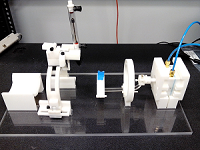
Hello everybody. I'm sure you're all busy preparing your deliverables, but since my partner's SURE Robotics program ends August 1st we have already finished our project. Here's a short refresher of what my project is all about. This is continuation of a project from Lauren's masters thesis and our job was to develop a pneumatic robotic device that can rotate the wrist. This procedure will allow automated performance of repetitive facilitation exercise (RFE) to treat stroke patients and involves synchronizing the brain stimulus with a mechanical stimulus. Currently, RFE is performed by a therapist but the variability is high because RFE requires precision within milliseconds, a feat impossible for humans. The challenge of the project is to make a fully MRI compatible device that is precise, so that RFE treatment can be repeated many times exactly the same way. The overall purpose is to optimize RFE by monitoring a patient through fMRI and to determine the best way to treat stroke patients.

We needed to build a prototype and make sure the accepted precision of the device is within +15 ms and a standard deviation of less than 5 ms. We designed a vane actuator, where compressed air rotates a shaft by pressurizing one side of a chamber. We also fabricated the coupling system between the hand clamp and the shaft, a rotary support to reduce the stress on the shaft, and put everything together from the ground up (note the part with the cylinder was made by the previous year's project). The last step is to conduct experiments to validate the accuracy of the robot. After much difficulty finding an adequate measuring instrument, we finally managed to determine the maximum standard deviation of the vane actuator is 2.9 ms with pressures over 30 psi. Then, a test is conducted on the final prototype with a load and fortunately the maximum deviation is calculated to be 4.4 ms with pressures over 42 psi. All in all, our project did meet the requirements for performing RFE but improvements should definitely be made. For instance, there is a significant amount of air leakage in the vane actuator which means the device is very inefficient. Moreover, the majority of the parts are 3D printed due to time constraints so the device needs to be made stronger.

I definitely learned a lot during my CCEFP experience. As it is my first time being involved in such a program, I figured out you can't be afraid to tackle on new problems. There will always be miscellaneous issues on the way and you can't let it dishearten you. Rather, it is important to struggle and do your best to make the most out of the situation. I had a lot of difficulty manufacturing certain parts for the project, but in the end the hands-on experience taught me much more about design than any class could. Well, I'm still working on my research paper, trying to make it as comprehensive as possible for my adviser, so I'll close off this blog by saying thanks to everybody who made this experience possible. To Alyssa, all my fellow REUs, and those who helped me from the CCEFP!